Bubble, Reverse.dev for Teams, and the Official MCP: A Practical Guide for Fast MVP Launches
Bubble is running two separate AI tracks: Reverse.dev for Teams, which maps GitHub codebases, and the upcoming official Bubble editor MCP. Here's what a non-technical founder needs to know to launch an MVP quickly without falling for developer hype.
Bubble just put out two AI-related updates that are easy to mix up: the launch of Reverse.dev for Teams and news about the official Bubble.io MCP. If you're about to ship a micro-SaaS or web product, the difference matters.
Without a formal technical background, your job at the earliest stage is simple: validate the idea fast. Get a working minimum viable product (MVP) in front of users, collect first feedback, or show traction to early investors. So I broke down how each tool works and where each one fits into that plan. Same topic: The BubbleGo Outage: What Actually.
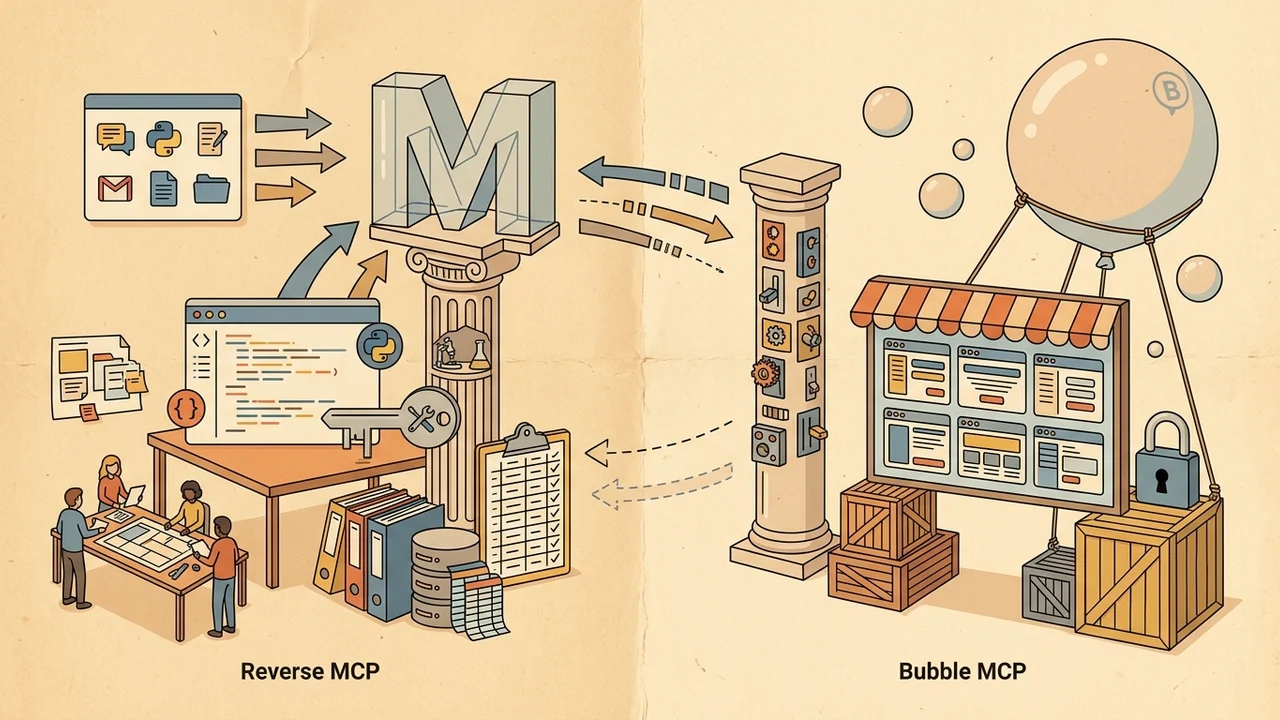
1. Clarifying the Split: Reverse MCP vs. Bubble MCP
Bubble Group, Inc. is running two parallel initiatives. They serve very different development workflows.
- Reverse.dev (Innovation Lab Experiment): Reverse is for code-first and vibe-coded apps stored in GitHub repositories. It supports JavaScript, TypeScript, Python, and Ruby. On September 29, 2026, Bubble staff announced Reverse for Teams. It adds multiplayer planning via Canvas, code-grounded Artifacts, Slack integration, and workspace role controls (Owner, Editor, Viewer). The key part: Reverse is a live MCP server today. External AI tools like Claude or ChatGPT can use it to read the visual architecture of a GitHub repository.
- Official Bubble.io MCP (Core Editor Integration): This one is a dedicated MCP integration for Bubble-native apps. Emmanuel Straschnov first outlined it in his September 2026 founder AMA, and it has since come up again in forum discussions as coming "very soon". It's designed to let external AI assistants inspect, create, and modify your Bubble app's UI and workflows without you working the web editor by hand. Same topic: SK AX AI Boot Camp. Same topic: Google Play (US): Private Vibe-Coded. Same topic: Reverse.dev for Teams: Can Bubble’s.
| Integration | What it is for | What it is not for | Availability & scope |
|---|---|---|---|
| Reverse.dev (Innovation Lab) | Code-first and vibe-coded apps stored in GitHub; languages include JavaScript, TypeScript, Python, and Ruby. External AI (e.g. Claude, ChatGPT) uses it as an MCP server to read the visual architecture of the repo. Reverse for Teams adds Canvas planning, code-grounded Artifacts, Slack integration, and workspace roles (Owner, Editor, Viewer). | Bubble-native apps built in the Bubble editor | Live MCP server today; Reverse for Teams announced September 29, 2026 |
| Official Bubble.io MCP (Core Editor) | Bubble-native apps: external AI assistants can inspect, create, and modify app UI and workflows without using the web editor by hand | GitHub / code-first repositories and non-Bubble app stacks | Outlined in Emmanuel Straschnov’s September 2026 founder AMA; forum discussions describe it as coming “very soon” |
Bubble staff said it plainly on the forum: Reverse MCP and Bubble's official MCP are not the same product. Reverse MCP is already live for codebases. The editor MCP is an upcoming core platform feature that's still in beta preparation.
2. Choosing Your MVP Stack as a Non-Technical Founder
Without an engineering team, I'd pick whichever path gets you to validated learning with the least operational friction.
Option A: Pure Bubble (No-Code Track)
- Best for: Founders who want one platform that handles databases, user authentication, responsive design, workflows, and cloud hosting out of the box.
- Current Action: Keep building in the Bubble editor. Don't rewrite your product in code just to try Reverse. When the official Bubble MCP arrives in beta, it will give you AI editing built around your Bubble app's structure.
Option B: Vibe-Coding + GitHub (Hybrid Track via Reverse.dev)
- Best for: Founders using AI code generators like Replit or Lovable, whose projects live in GitHub, but who find it hard to read and maintain raw code.
- Practical Advantage of Reverse: A visual map of the codebase, structured team planning in Canvas, and an MCP server for connected AI agents.
- Caveats: Reverse is explicitly a beta/POC experiment with credit-based workspace billing. The pull requests its agents generate still change production code. Review them with discipline before you merge.
3. Practical Rules for Launching in Days, Not Months
- Pick simplicity over new tooling. If your core value proposition needs standard user logins, database interactions, and Stripe checkout, building natively in Bubble is still the fastest way to your first paying customer.
- Keep branch discipline on vibe-coded repos. If you connect an AI-built app to Reverse, set Editor and Viewer roles carefully. Use preview environments, and don't auto-merge agent-generated pull requests into production branches.
- Watch real user metrics. Customers and angel investors look at retention, problem-solution fit, and customer feedback. They don't care whether your codebase was mapped via MCP. Pick the workflow that lets you launch and iterate fastest. A closer look: Bubble Reverse: GitHub as the.