Bubble September Roadmap: Official MCP Scope, External Agents, and Workflow Engine Alpha
Bubble is building an official Model Context Protocol (MCP) interface for external AI agents and reworking its workflow engine to support branching and loops. This is what I think non-technical builders should know before launching an MVP.
If you want to loop over a list in Bubble today, you end up with custom states, recursive backend workflows, or a third-party workaround. That was on my mind when I read September's announcements.
In September 2026, Bubble laid out its platform priorities in two places: Josh's community update and Emmanuel's recap of an AMA session. Two changes stand out. The first is an official Model Context Protocol (MCP) implementation that lets external AI agents build Bubble apps. The second is a full overhaul of the workflow engine. A closer look: Bubble September 2026 Update: The. A closer look: Bubble September Update: workflow alpha.
If you're a non-technical founder using vibe-coding to validate an MVP, both changes point to a faster and more flexible build process. Below I cover what was announced, how it works, and what to watch out for.
Official Bubble MCP: Editing Apps Beyond the Editor Canvas
Bubble is designing its upcoming MCP implementation as an open platform interface. Builders won't be limited to the in-editor AI Agent. They'll be able to connect external agents to build and modify their apps. Worth reading next: Bubble's Mobile Plugin Editor Hits.
What the official updates covered:
- Bring Your Own Agent & Model. You can work on your app with external tools and subscriptions, such as Claude or ChatGPT.
- Scoped Access Control. The app owner chooses which parts of the app and database an external agent can read or edit.
- UI, Features, and App Exploration. The demo showed an agent creating and editing app UI and functionality without opening the visual editor. It also showed an agent exploring an app and summarizing its architecture and behavior.
Context vs. Flexibility Tradeoff. In the AMA, Emmanuel said external agents give you freedom to work across your own tools. Bubble's in-editor Agent, though, still knows the platform's proprietary structure better. Bubble also plans a separate MCP effort that will let end-users query deployed Bubble apps. Work on that comes after the workflow revamp.
Workflow Engine Revamp: Native Branching and Loops
The second big milestone is a rebuilt workflow engine with native branching (if/else) and loops (for/while).
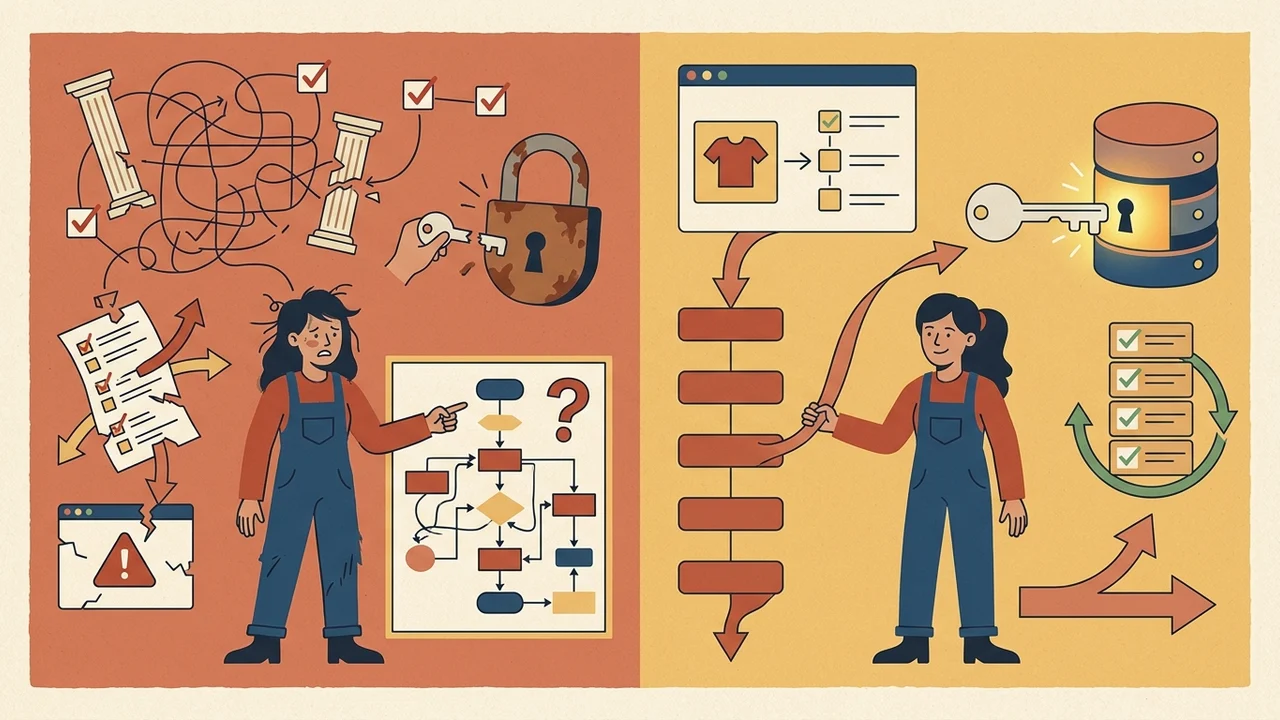
Until now, a non-technical builder who needed to process list items had to set up complex custom states, recursive backend workflows, or third-party workarounds. Native branching and loops make these patterns much simpler:
- Simpler logic for quick experiments. You can build automated user notifications, simple data processing, and validation rules step by step instead of splitting them across several workflows.
- A stronger base for API and agent backends. If your app acts as an API endpoint or an MCP data source, more expressive backend workflows keep payload execution consistent and structured.
Status and Realistic Planning for Founders
If you're preparing a launch for early October 2026, separate what's planned from what has actually shipped:
- Workflow Engine Alpha. The September 3 announcement invited builders to request early alpha access and said Bubble plans to open it "later this month." This is an early alpha preview, not a generally available production release.
- Bubble MCP Beta. The September 25 AMA recap put MCP beta access "within the next two to three weeks", which means roughly mid-October 2026. Exact tool boundaries, rollback handling, and pricing limits haven't been formalized yet. A closer look: Buildprint vs the Official Bubble. Same topic: Composio vs official Bubble MCP:.
If you're validating an early product right now, here's what I'd do. Build your core features in the editor, which already works. Keep your backend flows modular, so they benefit right away once native loops, branching, and agent automation roll out.