5M+ ChatGPT Sites in 3 months: what changes in distribution for a Bubble AI app
OpenAI's claim of 5M+ ChatGPT Sites created in 3 months highlights a core MVP reality: distribution and access beat feature depth. A practical framework for non-technical founders and solo Bubble builders.
Market Signal: 5 Million Sites in Three Months
On September 11, 2026, OpenAI's ChatGPT account shared a striking milestone: within roughly three months of the initial rollout of its Sites feature, users had created more than 5 million sites. Alongside this, OpenAI announced several updates: collaborative editing, private sharing, database inspection, custom domains, and a reported faster path from prompt to deployment.
For non-technical founders, solo builders, and vibe-coders looking to launch an MVP and gather early validation, this headline demands scrutiny. Before adopting the hype, let's separate verified facts from marketing noise:
- 5M is a top-of-funnel creation counter, not a measure of viable products. Generating a lightweight web page via prompt does not equate to an active business or regular visitors. Commentators have rightly pointed out that individual users could generate dozens of experimental drafts.
- It showcases the power of captive distribution. Users didn't have to register on a new third-party host, configure DNS records, or manage servers. Hosted URLs live directly inside the ChatGPT ecosystem, benefiting from its existing massive weekly user base.
- The battlefield is distribution speed, not product depth. Most of these 5M sites are simple landing pages, calculators, forms, or lightweight dashboards. Yet they went live instantly.
The "Feature Depth Trap" for Non-Technical Founders
A frequent misstep among non-technical creators aiming to test an idea fast is overbuilding. With visual development and AI-assisted coding, it is easy to spend weeks adding extra workflows, complex database structures, and multi-step logic before a single prospective user has ever visited the URL.
Founders often assume that investors or paying customers expect an enterprise-ready feature set on day one. The ChatGPT Sites signal proves the opposite: creation barriers have dropped to near zero. When anyone can generate a lightweight interactive app in minutes, having a basic AI wrapper is no longer a differentiator.
Your true competitive edge lies in how easily you reach users, how quickly they experience value, and how fast you capture feedback.
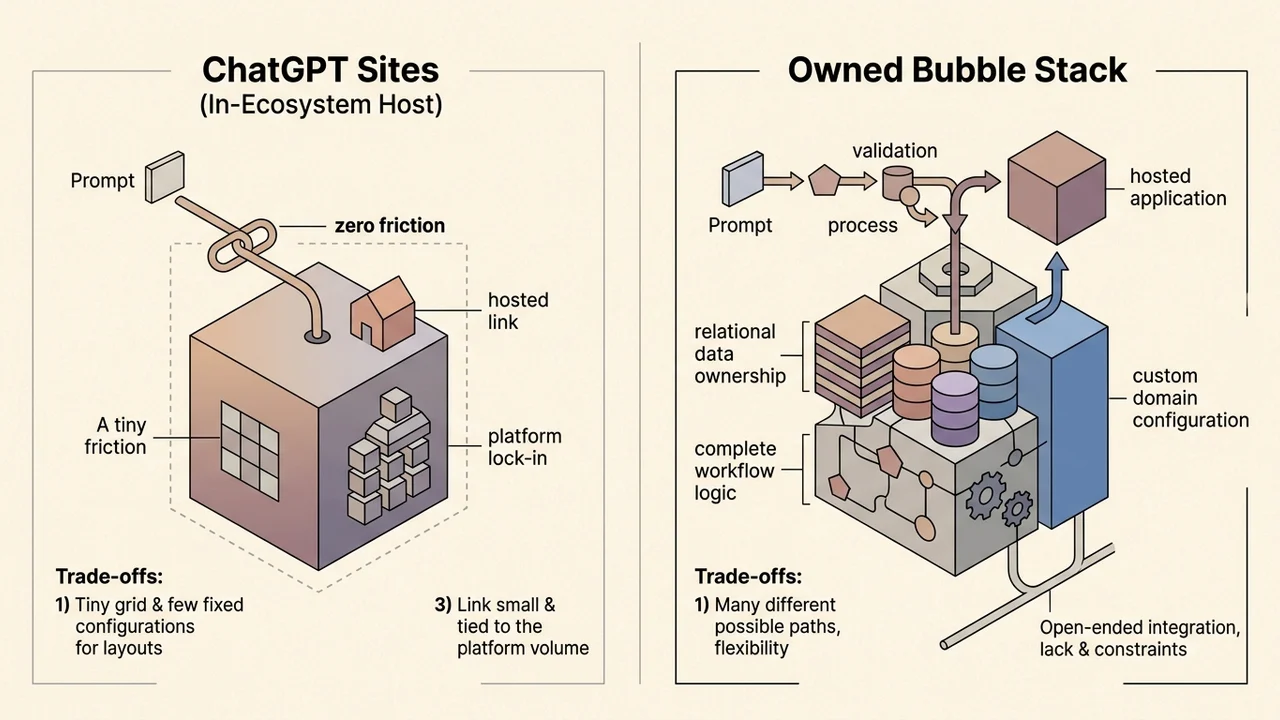
ChatGPT Sites vs. Owned Bubble Stack
To make smart architectural choices for an MVP, understand the contrast between an in-ecosystem generator and an owned no-code platform:
- ChatGPT Sites (In-Ecosystem Host):
- Strength: Zero friction from prompt to hosted link. Immediate shareability.
- Trade-off: Limited layout customization, platform lock-in, reliance on proprietary tier limits, and constraints on custom database rules or transaction flows.
- Bubble (Owned Visual Stack):
- Strength: Complete ownership over relational data, workflow logic, custom domain configurations, monetization, and native mobile distribution (via App Store and Google Play).
- Trade-off: Zero built-in distribution. The founder is 100% responsible for driving traffic, designing onboarding, and maintaining user retention from day one.
If you build on Bubble, your biggest risk is not a missing backend edge-case; it is building in isolation without a distribution channel.
A Solo Builder’s 3-Check Framework Before Coding
Before spending hours in the Bubble editor crafting complex workflows, evaluate your MVP against these three practical checks:
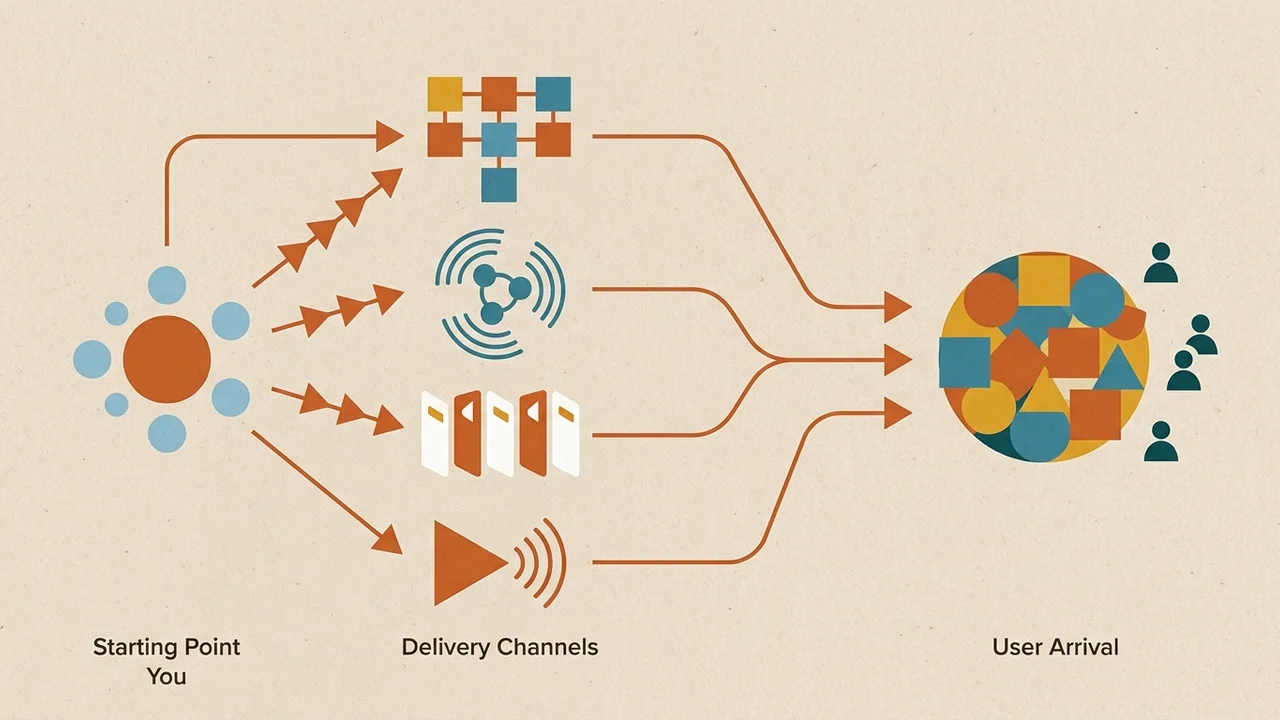
1. Delivery Channel: How will the first 20 users arrive?
Do you have direct access to the people whose problem you are solving? Relying on organic search or simply publishing a domain will leave your app stranded. Define your immediate channel: direct messages to ideal customers, niche community threads, outbound emails, or a concise Loom demo.
2. Time-to-Value: Can they experience the core feature in 30 seconds?
In ChatGPT Sites, users see immediate output in a chat thread. If your Bubble app forces visitors through email confirmation, complex onboarding surveys, and password setup before displaying value, you will lose the majority of your early traffic. For an early MVP, expose the core AI capability upfront, and only request sign-up when users want to save or export their results.
3. Built-In Feedback Loop
Do not wait for a "finished product" to ask for opinions. Place a clear feedback prompt or direct chat link directly on the main screen. When testing early concepts or talking to angel investors, qualitative feedback on why a user stayed or left matters far more than vanity metrics.
Key Takeaway
The milestone of 5 million ChatGPT Sites demonstrates that rapid deployment beats engineering depth at the idea-validation stage. For a non-technical builder on Bubble, the mandate is clear: keep your initial build strictly focused on a single valuable action, remove onboarding friction, and test your distribution before investing time into deep features.