AI Coding Benchmarks: How to Test a Tool on Your Own Bubble-Adjacent Tasks
Public leaderboards celebrate record scores on synthetic puzzles and skip the realities of no-code. Here is how I evaluate AI tools on my own Bubble-adjacent tasks so an MVP launches safely.
AI Coding Benchmarks: How to Test a Tool on Your Own Bubble-Adjacent Tasks
If you are a solo founder or a non-technical maker, the fastest route from an idea to paying users or early investor conversations is often Bubble plus pragmatic vibe-coding. That is how I approach it too. The goal is simple: launch a working Minimum Viable Product (MVP) fast, get early customer feedback, and check market demand without hiring an expensive engineering team. Same topic: Claude Code 2.1.287: What Non-Technical.
 Worth reading next: Using an AI Coding App.
To speed this up, founders pick an ai coding assistant or try autonomous ai coding agents, and they naturally start with public leaderboards. Every new model release comes with impressive scores across the well-known benchmark suites. Then you point the same model at a real Bubble project. It hallucinates database properties that don't exist, suggests standalone scripts Bubble can't run, or ignores critical security guardrails. Worth reading next: Shopify Canvas: Building a Storefront. Worth reading next: Why You Don't Need ai.
So before I choose a tool, I want to know three things: what the standard tests actually measure, what they miss, and how to build a practical private evaluation set from my own project.
What Public AI Coding Benchmarks Actually Test
Public benchmarks mostly fall into two families, each built around its own automated grading:
Code synthesis suites (HumanEval, MBPP, LiveCodeBench, Aider Polyglot). HumanEval measures functional correctness on 164 hand-written Python problems using pass@k. MBPP covers roughly 1,000 basic algorithmic problems. LiveCodeBench uses time-stamped programming competition challenges to prevent data contamination. Aider Polyglot tests multi-file code editing across 225 Exercism exercises in six languages. All of them ask whether code passes unit tests for isolated mathematical or algorithmic puzzles. None of them looks at architecture, maintainability, or integration with visual development platforms.
Repository-level issue solvers (SWE-bench, SWE-bench Verified). SWE-bench checks whether a model can resolve real GitHub issues in complex Python codebases by running its patches inside Docker containers. The original paper (Jimenez et al., ICLR 2024) says plainly that passing automated tests doesn't guarantee a patch is clean, efficient, or maintainable. Later analyses (SWE-Bench+, EvalPlus) showed that weak test harnesses can accept incomplete patches as valid solutions. And recent research like RealSWE found that real developer prompts are usually much shorter and less formal than benchmark issue descriptions, and models perform noticeably worse when they face that kind of realistic human phrasing.
None of these public suites tests what it's actually like to build a low-code web application.
The Bubble Blind Spot
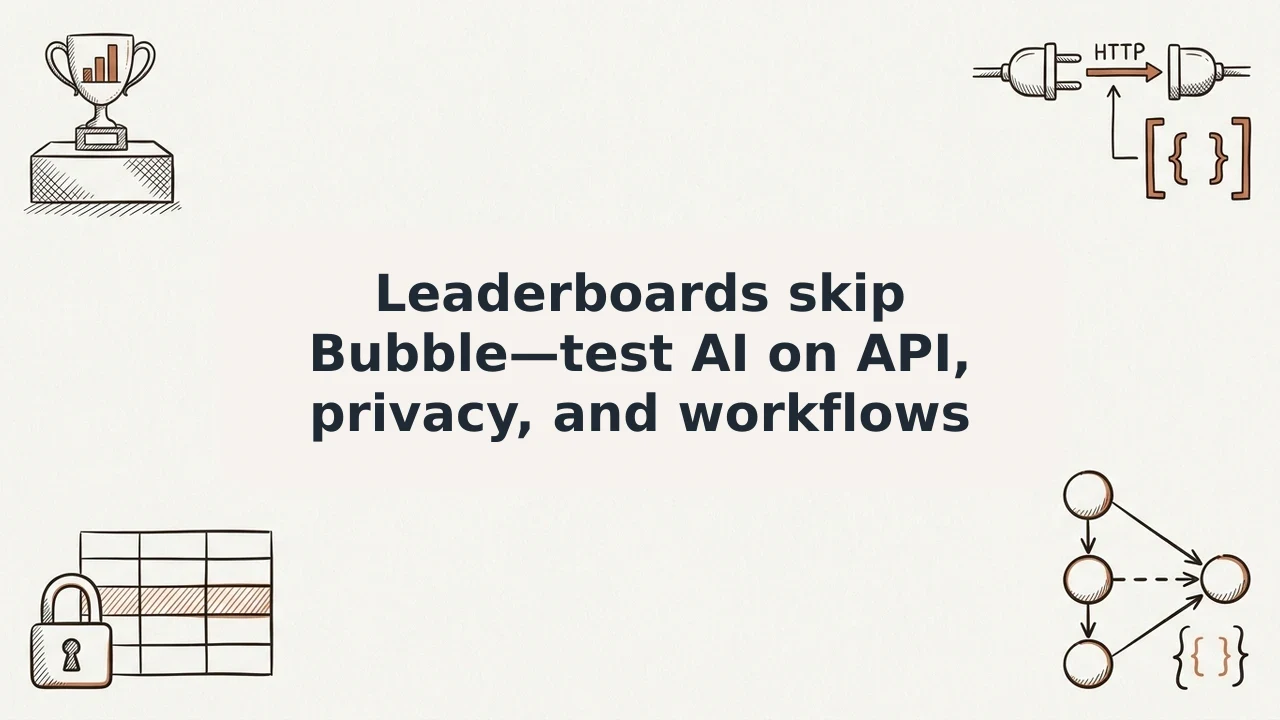
When I prepare an MVP for real users, my bottleneck is never a binary search in Python. It's Bubble-specific mechanics:
- API Connector Setup: the right HTTP methods, authentication headers, call initialization payloads, and mapping of nested JSON response keys.
- Privacy Rules: server-side conditions that stop unauthorized data exposure through the Bubble Data API or client-side searches.
- Plugin Architecture: custom JavaScript element or action logic that fits Bubble's Plugin API, meaning the
initializeandupdatelifecycle plus thepropertiesandcontextobjects. - Workflow Logic and Documentation: auditing multi-step workflows, such as payment processing followed by database updates, to catch race conditions before the app goes to early adopters or angels. Same topic: Bubble MCP server: Three Meanings.
Standard benchmarks have zero coverage of any of this. A tool that tops the leaderboards can still fail completely at configuring a simple webhook or protecting customer records.
Building a Private Test Set for Your MVP
I don't lean on third-party rankings. I build a lightweight private evaluation set from 4 to 5 tasks pulled straight from my own project backlog.
1. API Connector Spec Drafting
I take an excerpt from the third-party API docs I plan to integrate, such as Stripe Checkout or an email dispatch service. Then I ask the tool for the exact configuration Bubble needs: endpoint URL, headers, JSON body template, and parameter handling.
2. Privacy Rules Review
I give the model a simplified version of my database tables, for example Users, Subscriptions, and PrivateFiles. I ask it to define the server-side privacy rules that keep users from inspecting or searching other users' records through the Data API.
3. Custom Plugin Scripting
I ask for a self-contained JavaScript snippet for a plugin action or element, like parsing a custom date format or manipulating an input string. It has to follow Bubble's instance.publishState and properties conventions strictly.
4. Workflow Edge-Case Review
I outline a critical workflow, such as a user upgrading a subscription, and ask the tool to find edge cases, missing verification steps, or places where a network failure could leave database records inconsistent.
Security notice: I always redact production API keys, personal customer details, and private tokens before they go into a prompt.
Qualitative Evaluation (Without Invented Metrics)
You don't need automated evaluation scripts or complex scoring. I judge each candidate tool on three plain dimensions:
- Platform Fidelity: Does the tool respect Bubble's visual and architectural constraints, or does it tell me to install Node.js packages on a server I don't control?
- Security Awareness: Does it say outright that hiding an element on a page doesn't protect the underlying data without server-side Privacy Rules?
- Implementation Friction: Can I apply the generated spec or script within minutes, or did I just spend half an hour chasing syntax errors? Worth reading next: What a bubble.io App Actually.
LLM outputs vary between calls, so I run each test prompt 2 to 3 times to check consistency. I also re-run the whole mini-suite whenever a vendor updates the underlying model.
Conclusion
An MVP exists to test an idea and earn the first customers' trust, so it has to be reliable. Ai coding benchmarks alone won't tell you whether a tool can handle your particular low-code stack. A small private test set built from my actual Bubble tasks is what lets me pick an assistant that speeds up the launch instead of slipping in hidden security risks.