Business of Building 2026: 250k+ apps and monetization patterns for a solo Bubble developer
Bubble released The Business of Building 2026 report analyzing 250,000+ deployed apps. Here is how non-technical founders can apply its 4 monetization patterns to launch and validate an MVP quickly.
When launching an MVP with no-code tools and vibe coding, it is easy to get overwhelmed by high-level platform benchmarks. On September 8, 2026, Bubble published The Business of Building 2026, an empirical study based on observed behavior across more than 250,000 deployed applications during their first 180 days. Spanning 11.9 million deployments and 233 million edits over an 18-month cohort window, the report provides concrete observations on what distinguishes apps that process payments from those that do not. Same topic: Bubble Secrets Scanner: How to. A closer look: Bubble Business of Building 2026:.
For non-technical founders and solo makers seeking to test an idea, collect early customer feedback, or show traction to investors, the key is knowing how to translate these aggregate metrics into an actionable roadmap.
How Bubble Defines Monetization
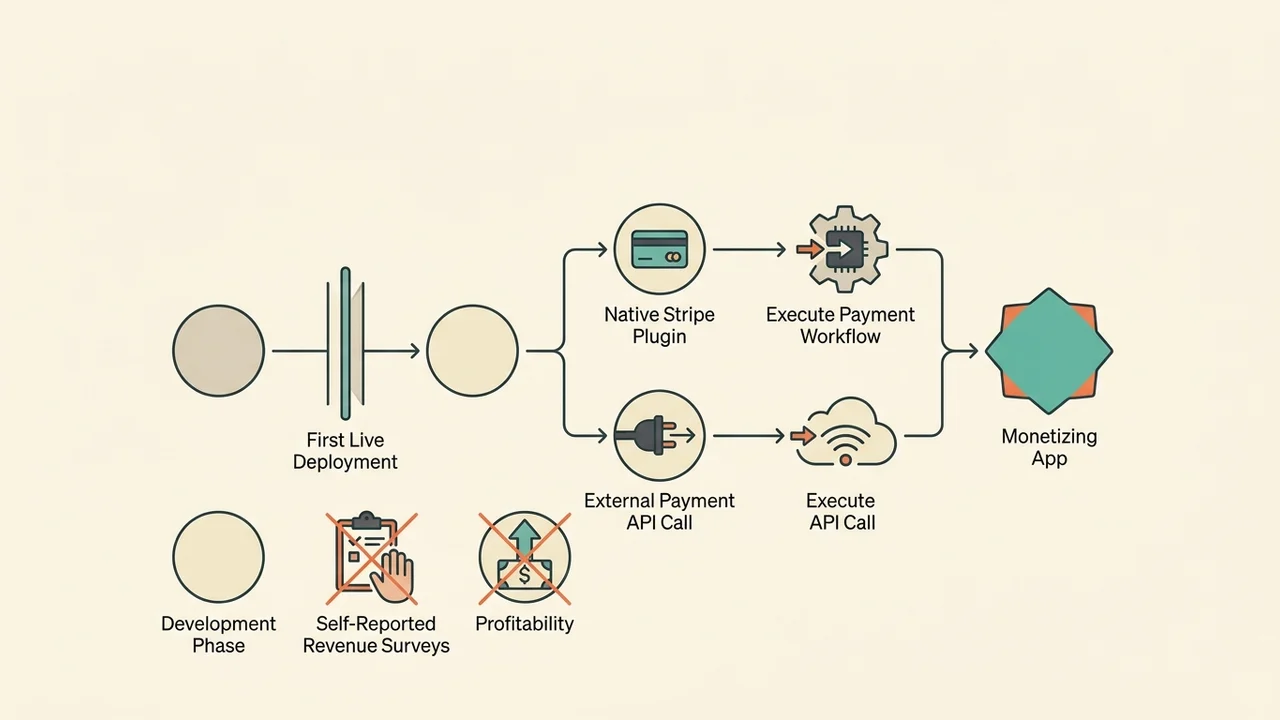
Bubble measures monetization strictly through observed behavior: an app counts as monetizing when it runs a payment workflow through the native Stripe plugin or executes an external payment API call on or after its first live deployment. It does not rely on self-reported revenue surveys, nor does it guarantee profitability—it simply tracks real transaction activity.
Critically for solo builders, 70% of monetizing apps were created by a single editor. While teams with 2+ editors showed a higher overall monetization rate (10.8% versus 7.5% for solo builders), the dataset confirms that solo execution is completely viable for launching revenue-generating software when scope is tightly controlled.
Translating the 4 Monetization Patterns into a Solo MVP
Bubble outlines four behavioral habits strongly associated with monetizing apps. These reflect cohort correlations rather than guaranteed causal steps:
Charge Early Among apps that generate revenue, approximately 31% begin charging users on day 1 of deployment, with a median time of 8 days from first deploy to the first payment workflow trigger. For an early-stage MVP, offering a free product indefinitely often delays real market validation. Connecting Bubble's native Stripe plugin takes hours, and asking for payment upfront is the fastest way to verify genuine customer willingness to pay.
Ship Steadily A typical monetizing application logs a median of ~45 deploys in its first six months, compared to just ~2 deploys for non-monetizing apps (a ~20× difference). For a solo founder, this cadence should represent responsive bug fixing and rapid iteration based on initial user friction, rather than shipping empty updates.
Edit Ruthlessly Monetizing applications logged a median of ~614 edits across ~46 distinct editing days within their first six months (versus ~25 edits across ~4 days for non-monetizing apps), with a median unbroken streak of ~9 days. The core advantage of no-code for non-technical creators is agility: you can refine copy, tweak database logic, and adjust onboarding flows in minutes without waiting for an engineering agency.
Build Boldly (AI Integration) Apps integrating external AI APIs exhibited a 28% monetization rate compared to 10% for apps without AI within the same cohort. In Bubble's AI generation prompt data, top categories centered on AI tools (38%), SaaS (33%), and marketplaces (15%). However, solo creators must manage token costs and output variability carefully. AI capabilities should address a distinct user pain point with strict usage limits rather than serving as superficial marketing gloss. Worth reading next: Bubble Business of Building 2026:.
Takeaways for Launching Your Idea
Bubble notes that the typical time from initial app creation to first live deploy is approximately 3 days. Do not spend months polishing unseen features. Build your primary user journey, hook up Stripe billing, get the product in front of real users, and iterate based on verified customer feedback.