‘Free Forever’ Is Not an MVP Price: Ideavo, GoDaddy Airo, and Where the First Invoice Appears
An app builder promises $0 or ‘free forever’, and a non-technical founder reads it as a launch budget. I went through where the first real invoices actually show up: BYOK API tokens, gated publishing, and entry tiers.
A founder with an MVP idea opens an AI app builder and sees ‘$0’, ‘Free forever’, or ‘free monthly credits’ on the landing page. The conclusion writes itself: version one will cost zero dollars. I get why. But a pricing page answers exactly one question: what it costs to open the editor. It says nothing about what it costs to run a live app that real people use. Same topic: What Bubble Really Costs for.
I looked at recent offers from Ideavo, GoDaddy Airo, and Atomic. The pattern is the same everywhere. The $0 sticker is a marketing entry point. The first real invoice sits on a different line item or shows up at the next step.
1. The BYOK Model: $0 to the Platform, Direct Invoices from the Model Provider
Ideavo launched with an aggressive pitch: the platform is free forever, with no mandatory subscription to use the builder. The free tier shows ads. You can remove them with an optional $20/month Pro plan. Baseline access really does cost nothing. Worth reading next: How Much Does an MVP.
The first invoice comes from BYOK (Bring Your Own Key). To generate code, interfaces, or logic, you plug in your own API key from OpenAI, Anthropic, or OpenRouter. Ideavo charges no platform fee and adds no markup on requests on the free tier. The AI provider, though, bills you directly for every token you use.
Then you need to deploy what you built. That means connecting your own hosting accounts, such as Vercel or Railway. Sandbox environments run on infrastructure like E2B. New E2B accounts get $100 in initial credits. Once those run out, E2B bills you separately.
What this means for a founder: a zero on the builder’s landing page only means the platform takes no middleman fee. Code generation, hosting, and your domain still come as separate invoices from third-party providers.
2. Free Generation, Gated Publication
GoDaddy Airo AI Builder does it differently. The free tier gives you 50 AI credits per month, and you don’t need a credit card to start. Agent and chat actions use credits. Manual code inspection, direct editing, and previews don’t. Same topic: MCP With No Credits and.
The marketing copy on the discover page says 50 credits are enough to build and publish a project. GoDaddy’s own learning documentation says something else: publishing requires an active paid plan. For commerce projects, you can’t publish a storefront or take customer orders without a paid subscription. No exceptions.
Paid starter plans at GoDaddy begin at $9.99/month on an annual commitment. Extra packs of 250 AI credits cost $24.99.
What this means for a founder: you can experiment and generate layouts without paying. But the moment your MVP needs a public link to collect feedback or process transactions, you hit the requirement for an active paid hosting or platform subscription.
3. The $25 Step: When the Sandbox Limit Runs Out
Other tools stick to a clear multi-tier structure. Atomic (atomicapp.dev by Abstract Machines) is preparing its launch with proposed plans: Free ($0), Builder ($25/mo), and Pro ($50/mo).
That mirrors the rest of the market. Lovable Pro sets its entry paid tier at $25/month, including 100 credits. Bolt Pro on bolt.new also starts at $25/month.
Every free tier gives you a strictly limited allowance of prompts or credits. Once your prototype needs real iterations, like setting up database relationships, handling authentication, or reworking screens after the first user tests, the free limit goes fast. The real entry point is the $20 to $25 monthly tier.

One more catch. Exporting code from these tools gives you the frontend and logic repository. It doesn’t include user management, a production database, or ongoing hosting. You still have to set those up and pay for them separately.
How Non-Technical Founders Should Budget an MVP
If you’re planning your first launch, don’t treat a marketing ‘$0’ as a project budget. I treat the free tier of any app builder as a trial: it helps you judge the interface. It is not a production environment for your business.
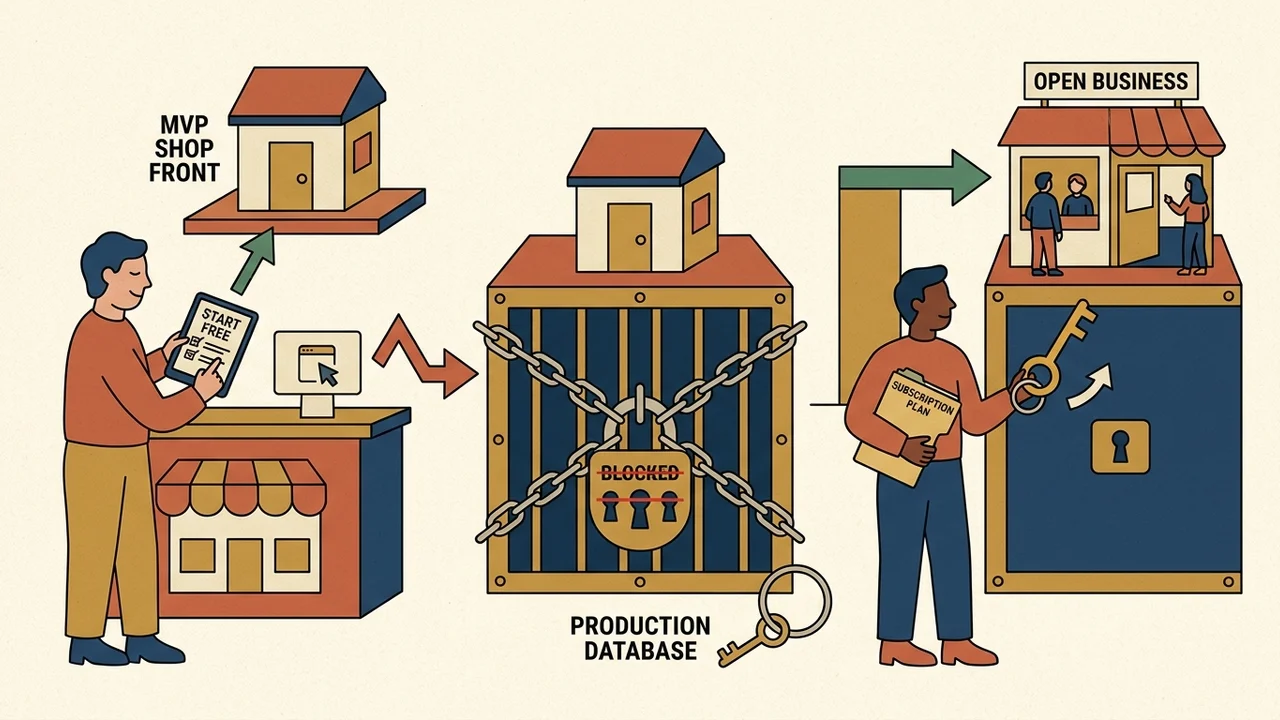
When I budget the minimum tooling costs for version one, I split them into three categories:
- Generation and Logic Refinement: AI usage costs (direct BYOK provider bills or a $20–$25/month tool subscription).
- Deployment and Public Access: hosting, custom domains, and production runtimes (starting around $10/month on bundled platforms, or standard hosting fees).
- Data and User Infrastructure: persistent databases and auth providers, which have their own limits and pricing tiers once you grow past demo records.
Once you can see these costs up front, your launch plan stays realistic. Pick the tool that gets you to a working, maintainable product fastest, not the one whose landing page shouted loudest about being free.