How to Read bubble.io careers and Developer Searches When Launching an MVP
Non-technical founders who want to test an idea fast often mix up Bubble careers with hiring a developer. Here is how those paths differ and what building an MVP actually involves.
I'm an independent developer, and the first conversation I have with a non-technical founder often starts with the same mix-up. They want to validate an idea in the market as quickly as possible, collect real feedback from early customers, and show traction to potential investors. They go looking for someone to build it, and search suggestions like bubble.io careers and developer job queries show up. Worth reading next: Who Should Build Your Bubble.
Now it's unclear what they're actually looking at. A role inside Bubble's own engineering department? An in-house software engineer on payroll? An independent builder who can deliver a functional minimum viable product (MVP)? Those are three different things. With no-code platforms and vibe coding, you no longer need months of traditional software development to turn a concept into a working product. You do need to know who you're hiring.
Here is how I separate the three paths, and what practical MVP delivery actually requires.
Three Distinct Worlds: Company Careers, In-House Roles, and Independent Builders
If you know where each kind of opportunity lives, you stop wasting time in the wrong place.
- Bubble the Company (Careers). Go to
bubble.io/careersor the open positions on Ashby (jobs.ashbyhq.com/bubble) and you'll see internal engineering openings for the platform itself: Engineering Manager, Senior Applied AI Engineer, Senior Software Engineer (Backend), and Software Engineer II (Platform). These engineers build and scale Bubble's underlying cloud platform on a traditional software stack (TypeScript, Node.js, Rust, PostgreSQL, Terraform, AWS). The roles typically require U.S. work authorization and Eastern Time alignment. These people don't build client applications in the visual editor. - Employed Bubble Developers (On Someone Else's Payroll). These are ongoing roles where a funded startup, a mature product company, or an agency hires a full-time builder. You'll find the listings on job boards and in the Jobs / Freelance category of the Bubble community forum (
forum.bubble.io/c/jobs-freelance/13). The work is maintaining existing production applications, complex backend workflows, and long-term product iteration. - Independent Practice (Freelancers and Studios). This is the path that fits an early-stage founder who is still validating an idea. You can find independent developers on Bubble Marketplace (
bubble.io/marketplace/), in the agency directory (bubble.io/agencies), or through thebubble.io/hire-a-developerintake. As an independent builder, I work directly with you to scope, build, and deploy a focused version of your product quickly.
Vibe Coding, No-Code, and Practical Reality: What Building an MVP Actually Involves
Vibe coding means using AI prompts and visual tools to assemble application interfaces fast. For a non-technical creator, it's an effective way to see the idea on screen. When founders go through bubble.io reviews while comparing technology options, rapid time-to-market keeps coming up as the main advantage. Worth reading next: Bubble, Reverse.dev for Teams, and.
But once a bubble.io app has to handle real user registrations, payments, and private data, the visual layout is only part of the work. In my practice, which lines up with the seven domains of the official Bubble certification, a launch holds up on four things: Same topic: Techshots’ Claude Artifacts “beta upgrade”.
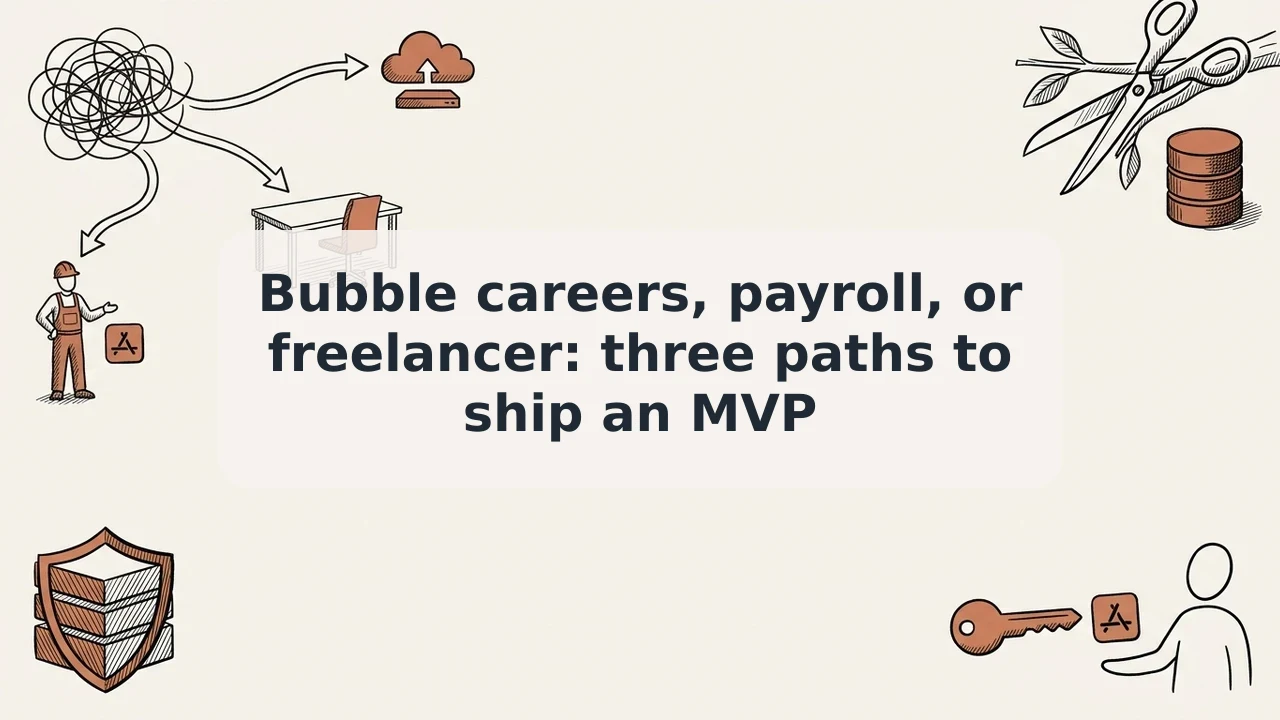
- Scoping: The most common trap for a non-technical founder is feature creep, trying to pack every long-term feature into version 1.0. I help strip away the secondary features and isolate the one core interaction that validates your value proposition. A lean scope shortens turnaround and saves budget.
- Data Architecture: I can redesign a user interface in an afternoon. A disorganized database structure is a different story: it causes performance bottlenecks once active users arrive. Defining data types, relational fields, and search constraints properly is what keeps the application reliable.
- Privacy Rules & Security: Security has to be configured at the database level. Beginners often try to protect sensitive information with visual conditions on page elements, not realizing the data still reaches the user's browser. Server-side Privacy Rules separate public information from private records and keep user data secure.
- Handover and Ownership Transfer: Delivering an MVP is more than sending a preview link. It means an official app ownership transfer to your account, documented workflows, and handing over the third-party API configurations. You need full ownership of your application when you raise capital or bring on team members later.
The Independent Path and Practical Takeaways
I chose independent development because working next to early-stage founders gives direct, measurable impact. Taking an unvalidated concept and turning it into a live tool that gathers the first customer feedback or investor interest is where no-code gives the most leverage.
If you're preparing to build your first product, here's what I'd do:
- Keep internal infrastructure roles at Bubble HQ separate in your head from hands-on product development for your startup;
- Use vibe coding to clarify your user flows, but stay strict about database design and security;
- Ship a tightly scoped MVP that tests your core hypothesis with real users before you build a complex product for demand you haven't validated.