OpenAI Agents API (public beta) vs Anthropic / Bedrock: what belongs in a Bubble backend
OpenAI rolled out the Agents API in public beta alongside Anthropic Claude Managed Agents and AWS Bedrock AgentCore. Here is an honest decision guide for no-code founders and vibecoders: when to leverage a managed agent harness, when to keep workflow logic inside Bubble, and how to get an MVP to market fast.
When you are building an MVP with no-code tools and vibecoding, your primary objective is speed to feedback. You need a working prototype in days to validate user interest, acquire your first paying customers, or secure angel funding. In that environment, adopting complex backend architectures prematurely is one of the fastest ways to stall momentum.
The recent release of OpenAI’s Agents API in public beta (requiring the OpenAI-Beta: agents=v1 header) has placed managed agent infrastructure back into the spotlight. As highlighted in InfoWorld by Anirban Ghoshal, OpenAI is competing directly with Anthropic’s Claude Managed Agents (in public beta since April 2026 under managed-agents-2026-04-01) and AWS Amazon Bedrock AgentCore harness, which reached General Availability (GA) in June 2026. While enterprise analysts emphasize how these APIs reduce moving parts, independent Bubble builders must evaluate what actually belongs in a fast-moving backend.
Understanding the Managed Harness
Building an autonomous agent from scratch usually requires substantial plumbing: task queues, session state databases, context compaction routines, retry loops, and isolated code execution sandboxes.
OpenAI’s Agents API packages this into a managed Codex harness. OpenAI runs session state, compaction, multi-agent coordination, Model Context Protocol (MCP) routing, and execution environments (environment.type: none, openai_hosted, self_hosted, or partner sandboxes). OpenAI specifies no separate platform fee beyond standard model, tool, and sandbox consumption. Anthropic provides an equivalent managed loop in Claude Managed Agents using an agent-environment-session-event model. Meanwhile, AWS Bedrock AgentCore offers a GA harness (CreateHarness / InvokeHarness) capable of switching model providers mid-session.
Why Managed Agents Can Slow Down an Early MVP
For non-technical founders looking to test an idea rapidly, delegating agent orchestration to an external managed API introduces notable trade-offs:
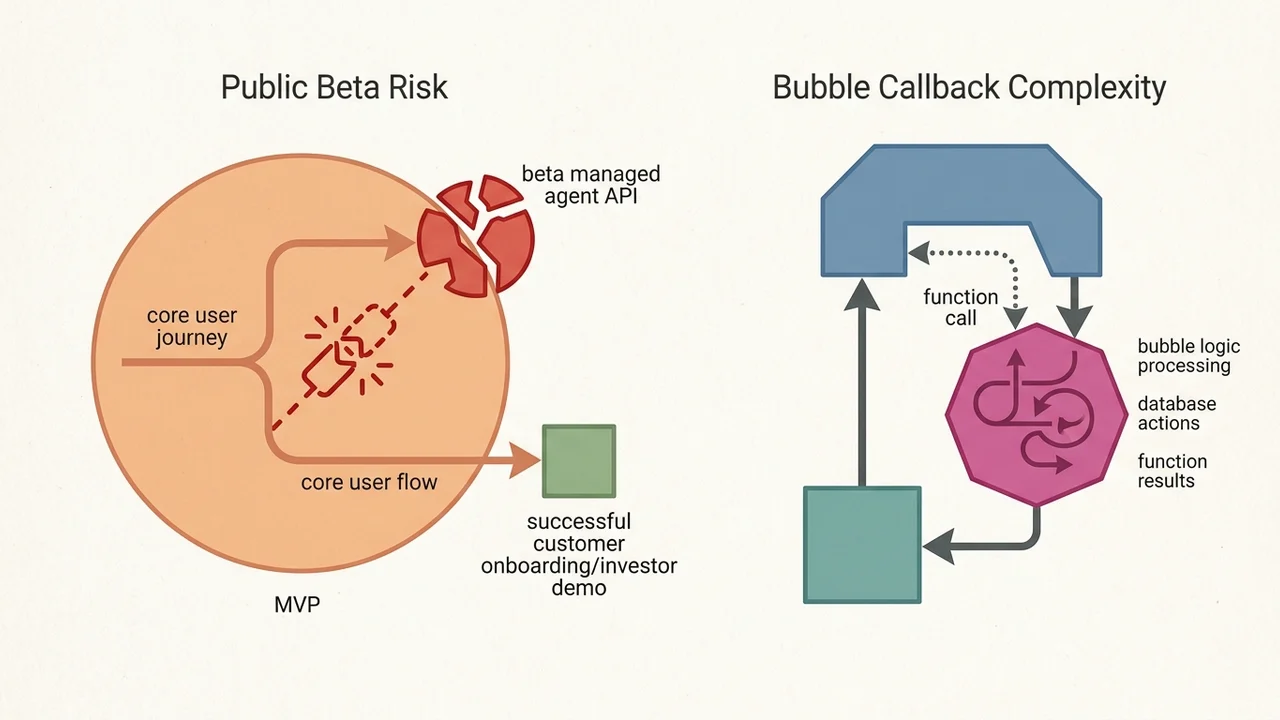
- Public Beta Risk: Both OpenAI Agents API and Claude Managed Agents are in public beta. Interfaces and operational behaviors are subject to iteration. Introducing beta dependencies into your core user journey right before customer onboarding or investor demos introduces avoidable platform risk.
- Bubble Callback Complexity: A managed agent must interact with your app to be useful. When an agent invokes a function tool to read your Bubble database or trigger an action, it issues a callback to your server. In Bubble, you must expose backend API workflows, configure webhooks, implement secure authentication, and handle async timeouts. If your function-tool handler experiences downtime or latency, the agent turn stalls. This increases rather than decreases integration effort.
- Data Residency and Zero Data Retention (ZDR): Official OpenAI documentation confirms that the Agents API operates under U.S.-only data residency and does not support Zero Data Retention (ZDR). As noted by Kanerika in InfoWorld, self-hosted sandboxes do not grant ZDR eligibility. Anthropic’s documentation similarly notes that Managed Agents is not ZDR or HIPAA BAA-eligible while sessions persist server-side. For founders building MVPs subject to strict data handling or EU customer expectations, this requires explicit risk evaluation.
- The AWS Bedrock Alternative: While AWS Bedrock AgentCore harness is GA and framework-agnostic, provisioning it requires managing AWS IAM roles, quotas, regional deployments, and Bedrock model access permissions. For a non-technical builder moving quickly on Bubble, this operational friction directly offsets the speed advantage of no-code.
The Bubble Backend Decision Matrix
- Keep Logic in Bubble (Recommended for 90% of MVPs): Connect to standard, stateless model endpoints (such as OpenAI Responses API or Chat Completions) via the Bubble API Connector. When a multi-step sequence is needed—such as evaluating inputs, executing database modifications, or interacting with payment gateways—manage it through Bubble Backend Workflows. A proven community approach uses scheduled backend workflows to loop until no tool call remains. This keeps application state, privacy controls, and business logic inside Bubble's visual editor where non-technical founders can monitor and debug every step.
- Adopt OpenAI Agents API or Claude Managed Agents: Reserve managed agent APIs for products where the primary selling point is autonomous, sandboxed execution—such as running user-submitted code or performing complex file processing inside a hosted sandbox (
openai_hosted). In those scenarios, avoiding custom sandbox fleet management justifies building the required Bubble webhook handlers.
Bottom Line
For early-stage validation, the simplest architecture is the most resilient. Stick with native Bubble workflows and standard API calls to validate product-market fit first. Introduce managed agent harnesses only when your product's core value proposition genuinely depends on server-side sandboxed execution.